The
French Drum has several notable features:
-
a long tradition, mainly military
(it is called also "Military
Drum") but use become much
more varied, with a constantly evolving repertoire,
either as part of musical groups,
or by providing of original works
only for drums from a growing number
of composers
-
a complex technique also changing
bases made rhythmic and combinations
called "rudiments" and
"coups" in France, usually
designated by an onomatopoeia
-
a teaching longer remained purely
oral or written based on empirical,
become methodical since the mid-20th
century (clear books, precise and
rigorous analysis: "Le Tambour
d'Ordonnance" volumes No. 1
& No. 2, by Robert Goute).
We
must add that the drum is often
not even considered as a musical
instrument in its own right, that
his comprehensive education is not
taught, except rare exceptions,
in National Schools, which occurs
in many forms, significant differences
(hardware , positions and gestures,
degree of sophistication) of a country
or a region of the world.
In
addition, the drum is an instrument
that is expressed usually in a group,
this group either alone or it is
part of an instrumental ensemble.
This
is a fundamental difference compared
to most other instruments of the
percussion family.
|
THE
INSTRUMENT
The
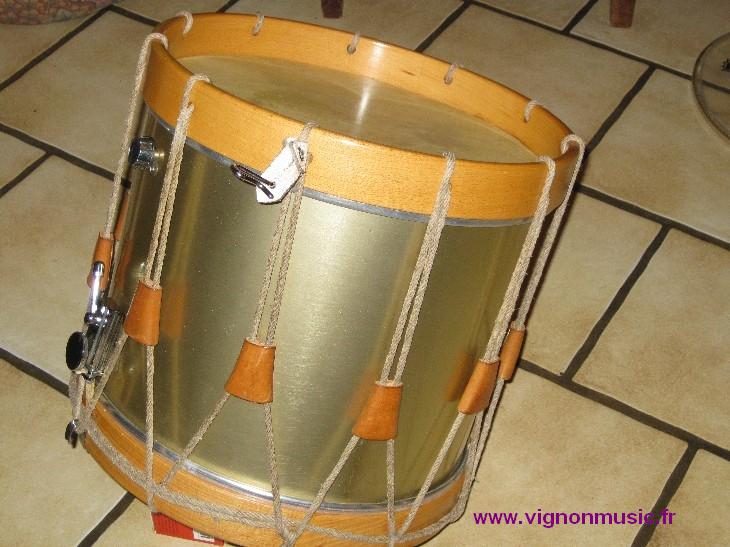
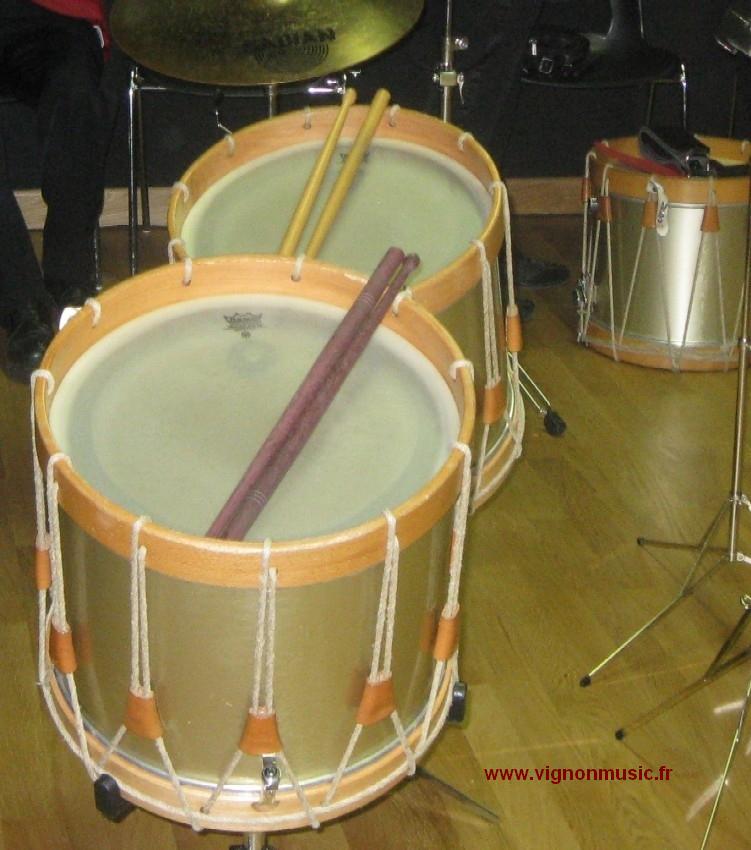
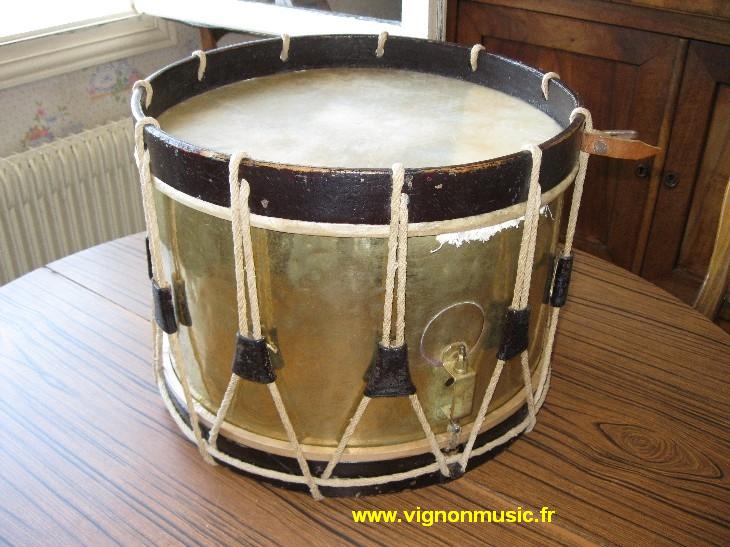
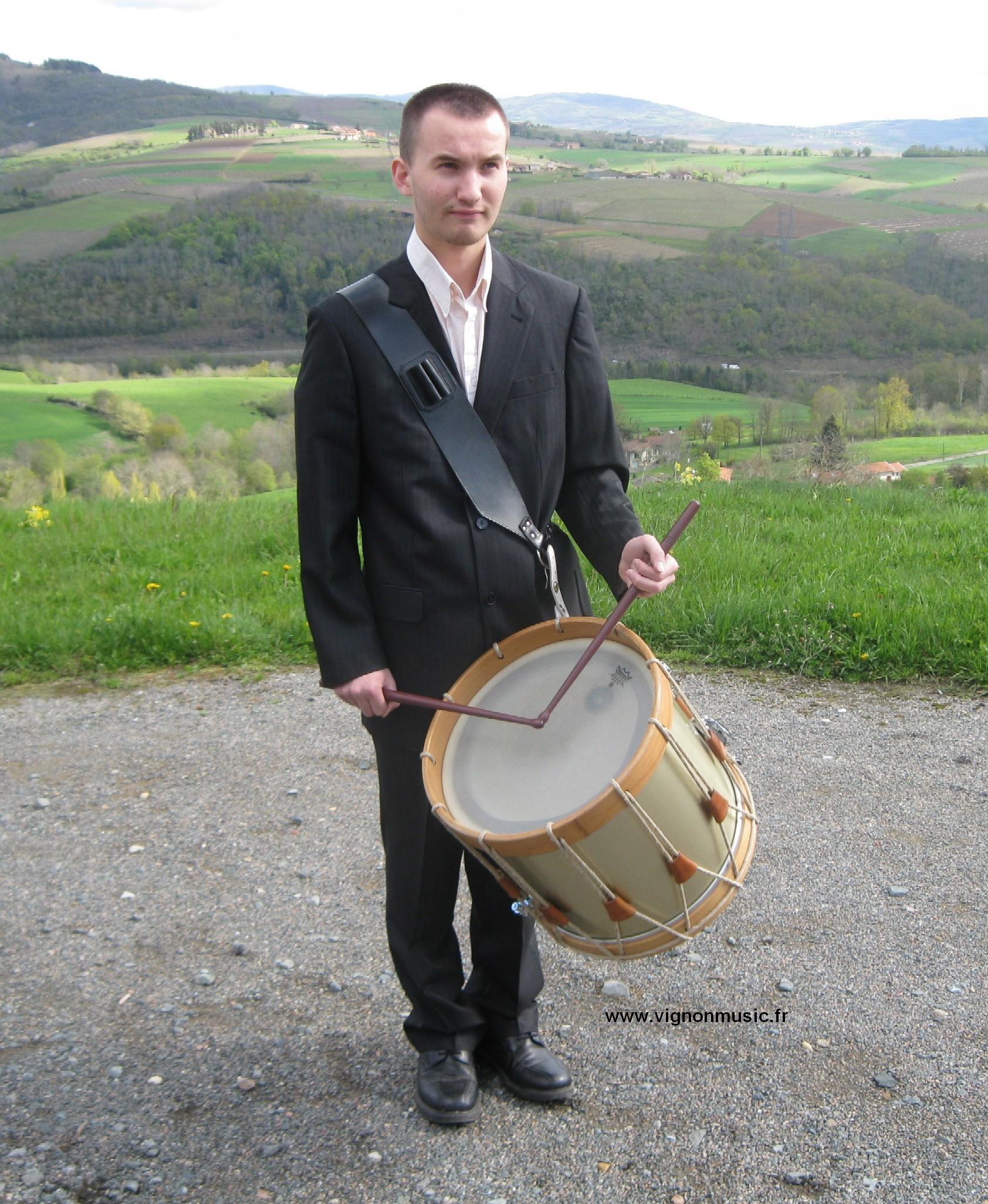
Drum (détails)
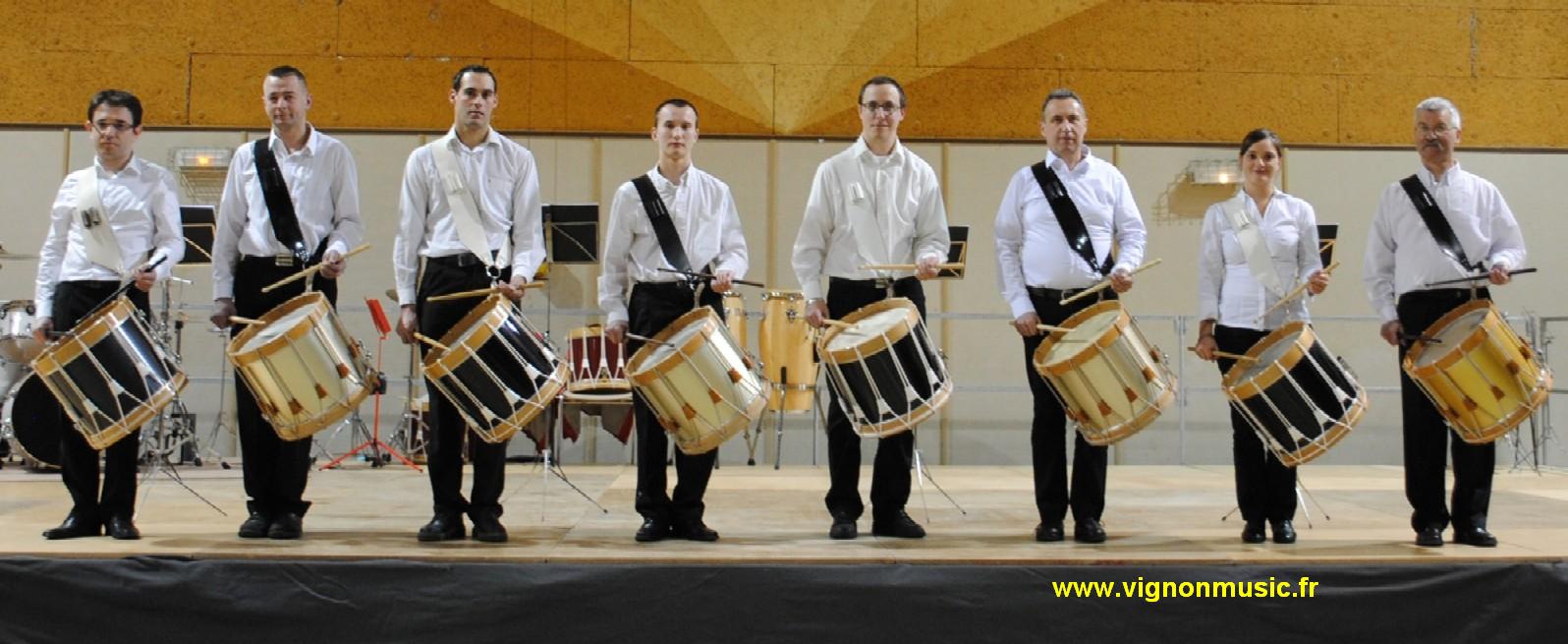
(photo1)
(photo2)
(photo3)
The
French Drum has evolved over history.
There
are now models also sometimes called
"parade" and often inspired
American (clamping rods or shells,
metallic wire), which are poorly
suited to the position,
technical and French repertoire,
two main models.
1°
- The "Military
Drum", with:
-
clamping rope made hemp (seven strands)
or synthetic, wooden heads and eleven
tightening straps in leather
-
metal body (copper, brass or stainless
steel) diameter 381 mm. (fifteen
inches) and deepness 205 mm.
-
natural bowels wires, consisting
of two or four strands, with throw off
-
for current use synthetic
skin, which replace the natural
skins (see
natural skin set-up) (in calf
or goat) that we prefer, however,
under appropriate conditions, such
as to play indoors.
2°
- This model being replaced increasingly
by the Drum "high" with
a body 305 mm. deep in various materials
(light metal, wood, synthetic resin)
and in all other points similar
to Military Drum described above.
This
latter type of Drum, more aesthetic
and better suited to walking and
providing a higher resonant volume
tends to spread.
For
the young pupils, we can find Drums
"three-quarters" (diameter
of the body 14 inches or 355 mm.)
and "half" (diameter of
the body 12 inches or 305 mm .,
even 13 inches or 331 mm.).
|
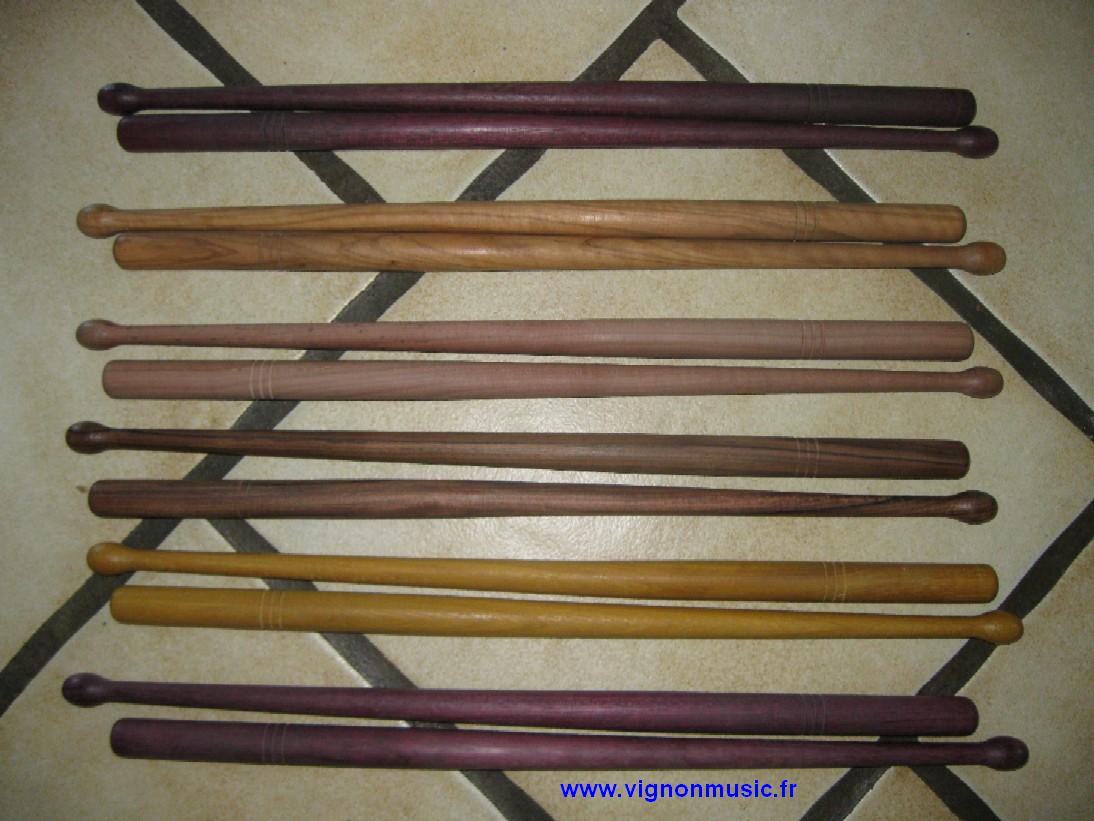
The sticks
The choice
of sticks is obviously of primary
importance.
Prefer
the sticks without metal tip, less
fragile and generally better balanced.
There
are of course different styles and
forms, but generally the length
is between 410 and 430 mm. , the
main diameter between 17.5 and 18.5
mm. , that of the olive between
14.5 and 16 mm.
Avoid
using sticks too light : a weight
of between 75 and 85 grams is satisfactory
and recommended.
For
(very) young students, there are
sticks a little shorter, thin and
light. Be careful to switch to sticks
"adult" as soon as the
morphology permits.
|
The
silent drum
The
Drum sound is naturally strong,
so it is often useful to work on
a silent drum. Courses are facilitated,
especially when they are collective,
the comments of Professor can be
done without stop the execution,
with more comfort.
And also , the daily practice is more
convenient, whatever is the environment.
It is important however to beat
regularly on the "real"
Drum, to get used to always different
touch to his work (this is particularly
true for example for the roll),
sound of the effects, attitude,
gesture and of course for playing
and marching.
There
are two types:
-
which consists of a buffer attached
to a belt left knee, which is sitting
practice
-
the "pad" silent drum
adjustable practicable seated or
standing-up, which is best for the
sound (do not choose a model too
"silent", making hard
work of expression) and especially
by the position similar to the real
Drum.
|
Maintenance
and settings
The
frame of mind and the quality of
the performer are a reflection of
care to maintain the appearance
and ensure the sound of his instrument.
We
shall careful of course about cleanliness
of the Drum. Teardown made from time to time will clean
inaccessible parts. It may take
the opportunity to change the position
of skins (rotated 120 ° for
example).
It
is always preferable to release
the Drum rope after each use.
For
giving the tension, we tight on
the straps, regularly and moderately,
in two rounds (per one has two).
The French Drum sound is deep, grave
without excess. The search for a
sound too clear by a high tension
generally leads to a decrease in
the volume.
We
choose and settle on the wires for
a fully effective since the lowest
"piano" to "forte"
the most important.
With
a correct assembly (see photos)
and adapted synthetic skins, the
defects of tone result generally
from one of the three talk following:
- an insufficient tension: re-stretch
the rope, uniformly
- amortization
of unwanted vibrations : the muffle
is often the solution
- badly
adapted, adjusted stamps, with differences
of tension between strands : change
them if needed and take time to
adjust them.
|
Ph.V.
1996-14-07
|
 THE DRUM: What is it ?
 version
en Français - According
to the
version
en Français - According
to the 
 photos
collection
photos
collection